
Preparing your boat for a canal holiday
Right of way: the principles that actually matter
On the road, right of way is settled by law and by lines painted on the tarmac. Afloat it is different. On most UK rivers and canals there is no absolute right of way — there is a shared duty to keep a proper lookout, plus conventions that tell you who is expected to give way when everyone is behaving sensibly.
Three principles cover most situations:
- The less manoeuvrable boat has priority. Powered craft give way to sailing boats under sail, rowers, canoes and paddleboards. Small leisure boats give way to loaded commercial craft, dredgers and ferries, which cannot stop or turn quickly.
- The boat with the best view should act first. If you can see the whole picture and the other skipper cannot, it is up to you to make the safe decision early.
- Doubt means slow down. If you are unsure what another boat is doing, ease off, sound a signal and give yourself time.
Right of way, in other words, is a courtesy you extend rather than a prize you win.
Meeting head-on, crossing and overtaking
When you meet another boat head-on, the convention on most UK inland waterways is to keep to the right — you pass port side to port side, each boat keeping to its own right-hand side of the channel. That surprises people who drive on the left, but it is the rule afloat. Any local variation will be covered by the navigation authority's byelaws for that waterway, which are worth a read before you cruise an unfamiliar river.
Crossing? The boat that has the other on its starboard (right) side gives way. In practice, ease off early and pass astern rather than trying to nip in front.
Overtaking is always the responsibility of the boat coming up from behind. The boat being overtaken should hold a steady course, move right if there is room, and slow down to make the pass quick. Never overtake where the channel narrows, at a bridge, or on a blind bend. Patience is almost always faster than a scrape.
Speed limits and the wash you leave behind
Most canals carry a blanket limit of around 4 mph, which for a narrowboat is often close to flat out anyway. River limits vary widely — some stretches are effectively unrestricted, while others carry byelaws of 5 mph, 8 km/h or something similar.
The number matters less than the wash. A useful working rule: if you are leaving a breaking wave against the bank, you are going too fast, whatever the sign says. Wash erodes banks, rocks moored boats and upsets wildlife.
- Slow down well before moored boats and pass them at tickover.
- Watch your wash in shallows and on bends — the same throttle setting makes a much bigger wave in shallow water.
- Ease right down when passing anglers, rowers, canoes and anyone working at the water's edge.
- Remember that a heavy displacement hull shifts a lot of water even at walking pace.
Bridges, narrow channels and blind bends
Bridges concentrate everything that makes boating tricky: current, traffic and no room for error. Approach at a speed that lets you stop within the distance you can see.
- Read the signage — many bridges carry a headroom gauge, and if the figure is close to your air draught, do not gamble.
- Use the main navigable arch, usually where the flow is strongest and often marked with a sign, an arrow or a diamond.
- Beware of weirs and odd currents around side arches; a wide arch is not automatically a safe one.
- Sound one prolonged blast before a blind arch or a bend with no view, and listen for an answer. If someone replies, wait.
- Never overtake under a bridge or in a narrow channel.
On tidal reaches, time your passage so you are not fighting the ebb through a bridge pier. Slack water is your friend.
Signals worth knowing
Sound signals are used far more on rivers and tidal water than on quiet canals, but they cost nothing to learn. A short blast lasts about a second; a prolonged blast is four to six seconds.
- One short blast: I am altering course to starboard (right).
- Two short blasts: I am altering course to port (left).
- Three short blasts: I am going astern.
- Five or more short blasts: I am unsure of your intentions — or there is danger.
- One prolonged blast: warning — approaching a blind bend, narrow channel or bridge arch.
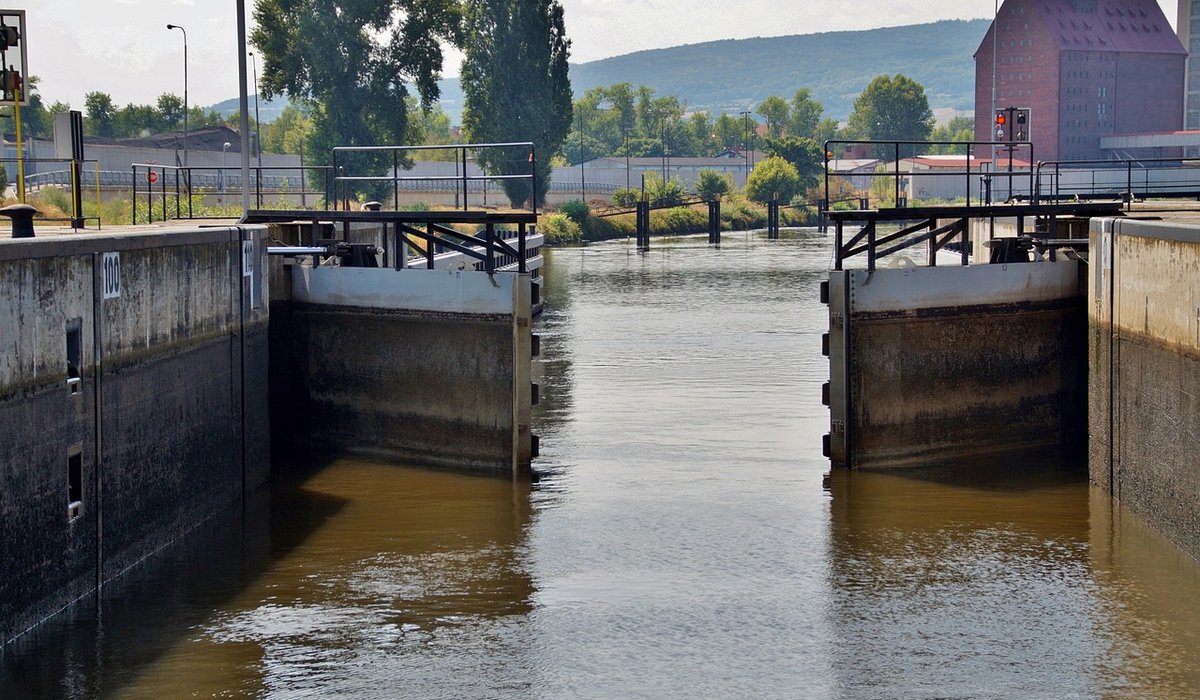
Light signals matter just as much. Locks and many narrow bridges use traffic lights: green means you may proceed, red means stop and wait, and amber means prepare to stop. Never pass a red light because the channel looks clear — something may be coming that you cannot yet see.
Small courtesies that make a big difference
Navigation rules exist so that strangers can share a waterway without having to guess what each other will do. A few habits will keep you on the right side of everyone.
- Look behind as often as you look ahead — you are responsible for what you run into.
- Acknowledge other boaters with a wave or a nod. It costs nothing and builds goodwill on a shared stretch of water.
- Moor considerately: not at a winding hole, not blocking a lock landing, and not so close to another boat that you are sharing fenders.
- Keep noise down near houses, moored boats and wildlife, especially early and late in the day.
- If you get it wrong, say so. A cheerful apology defuses almost any incident on the water.
Cruising well is mostly about anticipating — reading the water, the weather and the boats around you, and acting early rather than late. Get that habit and the rules become second nature.
LEAVE A COMMENT